Save on unnecessary moves
Fewer hotel changes can reduce transfers and lost sightseeing time. Keep Otaru as a Sapporo day trip when that fits your interests, and choose a small number of countryside bases.
Budget planning · Japanese yen
Separate room nights, person-days and vehicle prices. Use transparent examples, then replace the assumptions with your own dated bookings.
Your Hokkaido travel cost depends as much on how you move as on how you sleep. A Sapporo hotel with rail day trips is a different budget from a winter ski stay, and a private vehicle is shared by the group rather than charged once per passenger. A useful estimate keeps those units separate from the start.
The figures below are HokkaidoMe’s illustrative planning allowances in Japanese yen, prepared in October 2026. They are not live hotel offers, measured market averages or a package quote. They help you build a first worksheet before replacing the assumptions with dated bookings. Flights and transport are deliberately added separately because they depend strongly on the route.
| Expense and unit | Budget example | Comfortable example | Premium example |
|---|---|---|---|
| Accommodation | Dorm / simple stay: JPY 5,000–8,000 per person, per night | Double room for two: JPY 16,000–30,000 per room, per night | Premium room for two: JPY 40,000–100,000+ per room, per night |
| Food, per person per day | JPY 2,500–4,000 | JPY 4,000–7,000 | JPY 10,000–20,000+ |
| Activities, per person per day | JPY 500–1,500 | JPY 1,000–3,000 | JPY 3,000–10,000+ |
| Illustrative daily base, per person | JPY 8,000–13,500 | JPY 13,000–25,000 when sharing that room | JPY 33,000–80,000+ when sharing that room |
| Add separately in every column | Flights; actual transport; insurance; shopping; equipment; any taxes or fees not included; reserve | Same exclusions | Same exclusions |
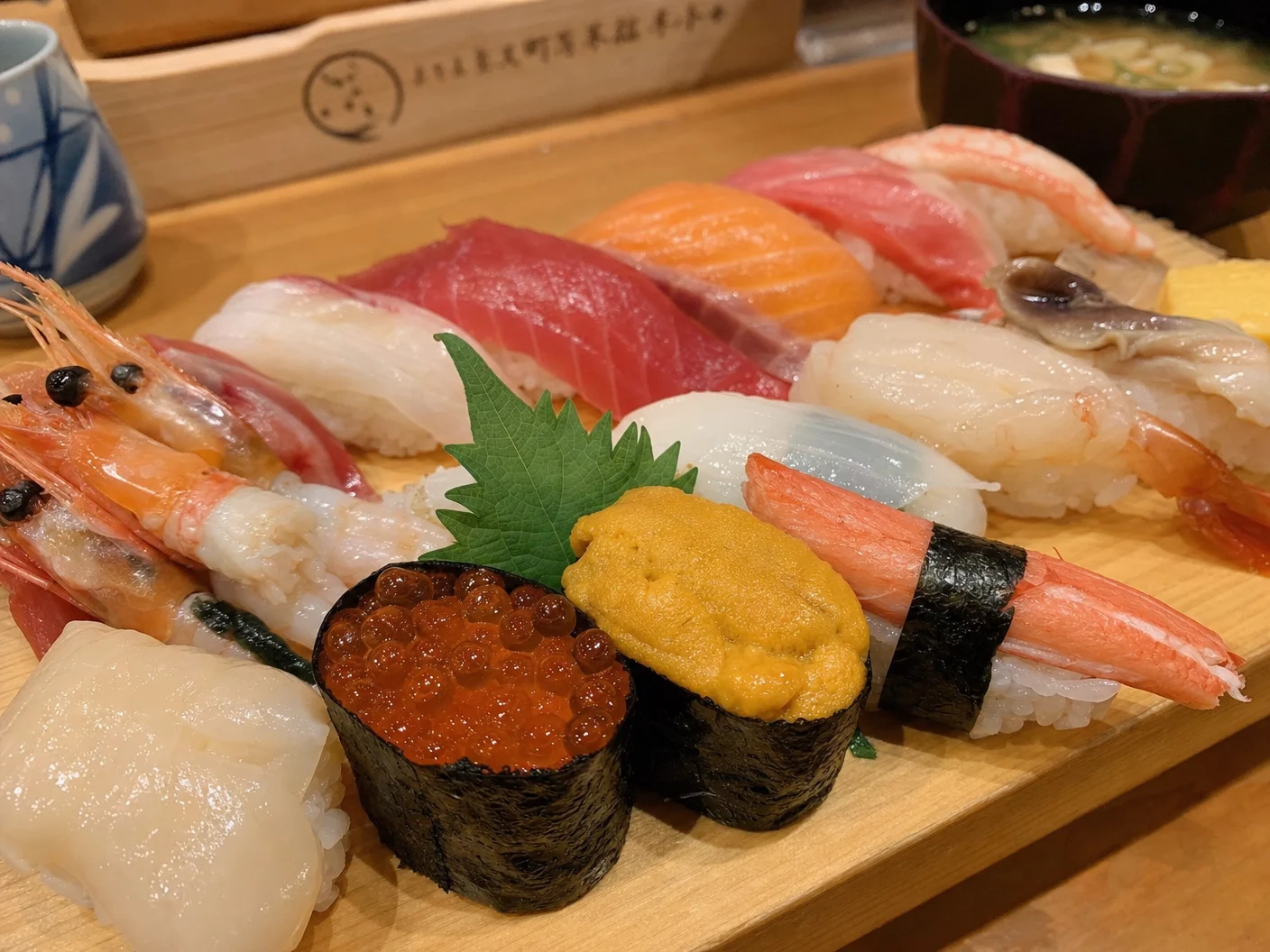
Here is a transparent starting worksheet for a couple sharing one room. The example uses the same six-night structure as our seven-day itinerary. It assumes a JPY 16,000 room each night, JPY 4,000 of food per person each day, and JPY 1,000 of activities per person each day. It does not claim you will find that room or spend exactly that amount.
Six room nights cost JPY 96,000. Fourteen person-days of food cost JPY 56,000, and fourteen person-days of activities cost JPY 14,000. The base is therefore JPY 166,000 for two people, or JPY 83,000 each before transport and the other exclusions. This arithmetic is more useful than one attractive daily total with an unclear lodging unit.
Next, add all transport for the actual route: airport connections, intercity tickets, city fares and the journeys from rural stations to sights or accommodation. If you choose one private sightseeing day, enter that vehicle’s full written quote once in the party total. Do not also count train tickets for a journey you will no longer take.
Finally, add flights, travel insurance, shopping and any equipment or special activities. Keep a reserve appropriate to your travel style; for example, 10–15% of your planned ground spending can be a starting budgeting choice, rather than a guarantee that every disruption is covered. Review what is refundable and what must be paid in advance.
For two adults, compare the final room total for the same dates, occupancy and cancellation terms. Check whether breakfast, local taxes and any bathing tax are included. A room that appears cheaper can cost more after adding breakfasts, extra beds or the transport needed to reach it. With children, enter their actual ages and check the property’s bed and meal rules.
A traditional inn may price a stay per person with dinner and breakfast. A city hotel often lists one room without dinner. To compare them fairly, put the ryokan’s included meals into your worksheet and remove the separate meal allowance for those meals. Check the last dinner check-in time before booking a long transfer on the same day.
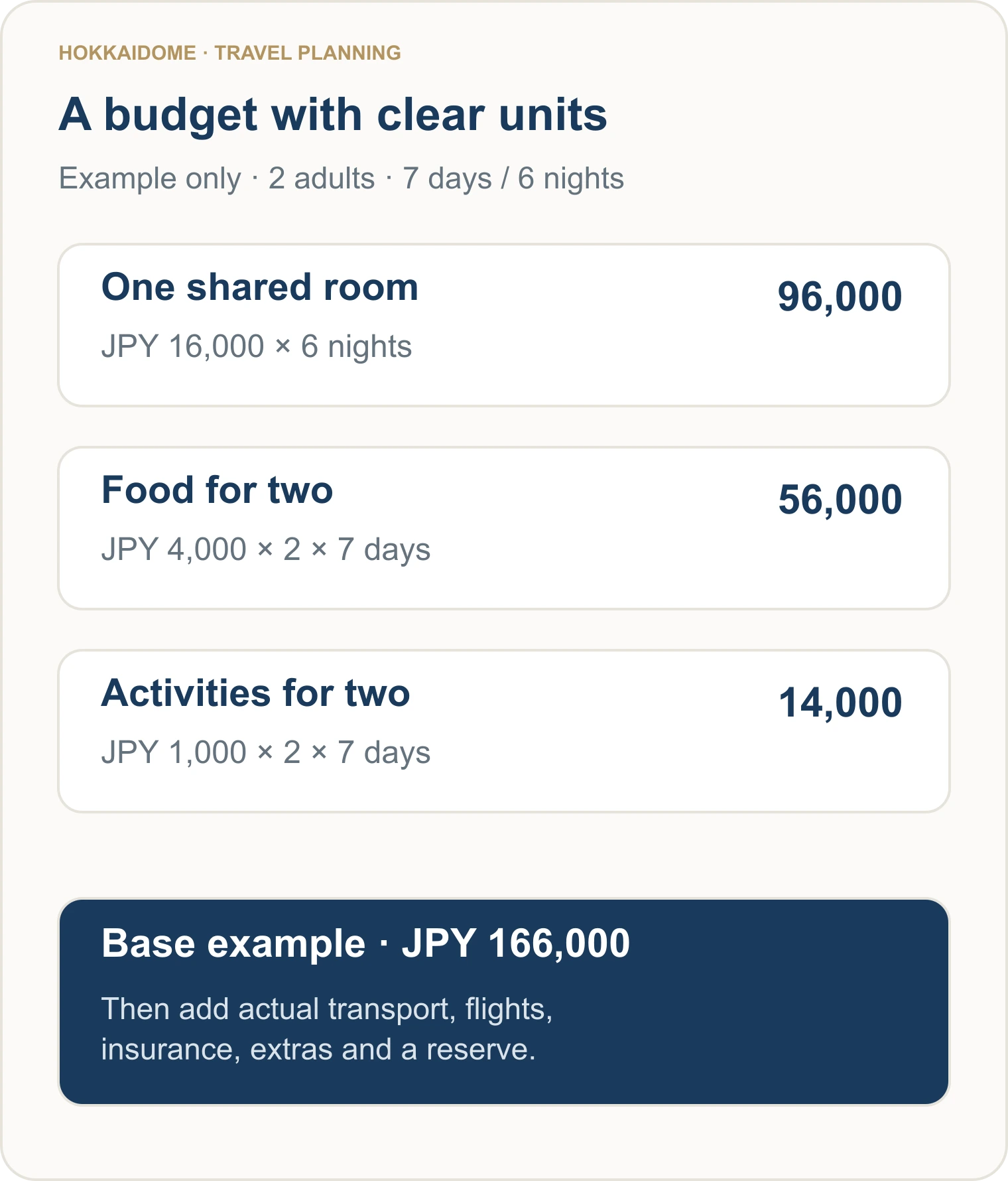
Location can matter more than the star rating. In Sapporo, a practical station or neighbourhood base can reduce taxis. Around Furano or Biei, a scenic lodge can create an evening transport need if restaurants are far away. In a ski resort, compare the real village, lift or shuttle access and the equipment space; a resort-area address alone does not establish convenience.
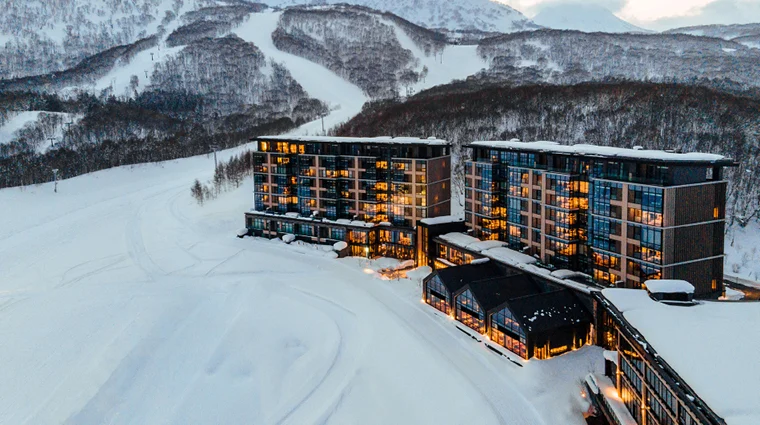
A good food budget can mix simple breakfasts, a casual lunch and a meal you are excited about. Decide which experiences matter: ramen, soup curry, seafood bowls, sushi or a carefully planned restaurant evening. You do not need to make every meal premium to enjoy Hokkaido, and a convenience-store breakfast does not prevent a special dinner.
Check current menus, service charges, booking deposits and drink prices. A photographed seafood bowl is not evidence of today’s price or the same ingredients being available in every season. If someone has an allergy or a specific dietary requirement, confirm it with the restaurant instead of relying only on an English dish name.
For the two-adult worksheet, JPY 4,000 per person per day is an example allowance to replace with your choices. If breakfast is included, reduce the breakfast line. If you book a tasting menu, enter its actual total instead of hoping the daily allowance will absorb it. Keep cash or a suitable payment method for small establishments according to their current rules.
Write a transport ledger with one row for every journey: airport to hotel, Sapporo to Otaru and back, the countryside move, local sightseeing and the final airport trip. Mark whether each price is per person or per vehicle. Include reserved-seat requirements, onward buses or taxis and any luggage arrangements. A rail station on the map is not necessarily beside the hotel or attraction.
Rail-pass value depends on the journeys and valid dates, not the number of nights in Hokkaido. At the time of review, JR Hokkaido lists the four-day Sapporo–Furano Area Pass at JPY 11,000 for an adult and the seven-day Hokkaido Rail Pass at JPY 28,000 when pre-purchased, with different station purchase prices. Check the current eligibility and coverage before paying; subways and other excluded transport need separate fares.
For self-driving, compare the full rental offer: vehicle class, insurance or optional cover, fuel, tolls, parking, pickup and return locations, and any one-way fee. A daily rental headline does not include every road expense. For rail or highway buses, check service dates and reservation rules rather than relying on an older blog’s fare.
You can also mix transport. Use public transport for the city days and book a private Furano and Biei day or a hotel change with sightseeing where it helps. Our guide to travelling without a car explains the missing countryside connections to check.
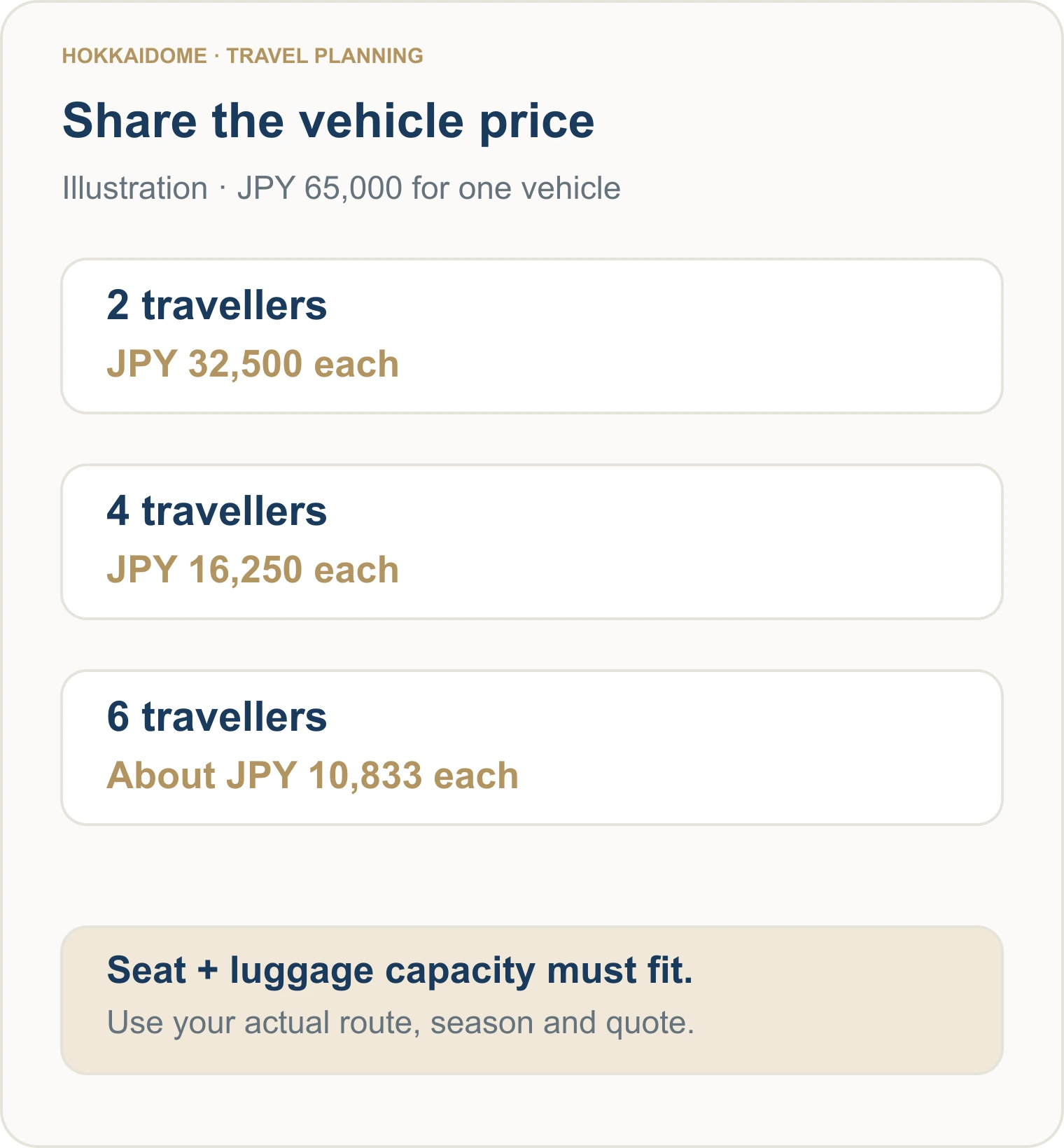
Private transport is best compared as one vehicle service for a stated route and duration. For example, HokkaidoMe’s published April–November Biei/Furano Alphard starting rate is JPY 65,000 per vehicle for up to ten hours. Dividing that starting amount by two gives JPY 32,500 each; by four, JPY 16,250 each. It is not a per-person ticket price or proof that private travel always costs less.
The image also shows an arithmetic split for six people. That does not confirm that six travellers, their cases and any child seats fit a particular vehicle. Confirm the layout and all luggage before relying on a split. The actual quote can change with the route, season, vehicle, extra hours or overnight arrangements.
Our current charter prices and conditions state the published inclusions, including fuel, expressway tolls and parking for the quoted charter. Admissions, meals, specialist guiding and other items belong in the total only when included in writing. An airport transfer is a different product: see the specific Sapporo or Niseko page rather than converting a sightseeing day rate into an assumed airport fare.
Tell the planning team what you intend to do independently. A selected countryside day may be the most useful paid help, while a full city stay may need little private driving. We communicate in English; drivers use conversational English and translation apps, and specialist guiding is a separate request. Availability and the final amount are confirmed before booking.
Fewer hotel changes can reduce transfers and lost sightseeing time. Keep Otaru as a Sapporo day trip when that fits your interests, and choose a small number of countryside bases.
Put money into the experience that matters: a chosen ryokan meal, a suitable room, a rural day, an accessible route or enough vehicle space. Compare its actual benefit to your group.
Budget for a workable airport journey and, if needed, the right final-night location. A cheap room or late train is not a saving if it cannot meet your flight requirements.
Travellers paying from the United States, Australia, Singapore, Hong Kong, Taiwan or South Korea can all use the same yen worksheet. Convert the final yen amount using your own payment provider’s rate and fees. Do not mix USD, AUD, SGD, HKD, TWD or KRW totals without labelling the conversion date and basis.
Before reserving, check which payments are already included in another booking. Common double counts include ryokan meals, transport included in a tour, or a hotel breakfast charged again in the food allowance. Common omissions include airport journeys, ski equipment, parking, extra rooms and activities priced separately for children. A final line-by-line review catches more errors than a single “budget” or “luxury” label.
Start with your accommodation style and group size. This guide’s illustrative daily base allowances are JPY 8,000–13,500 for a budget traveller, JPY 13,000–25,000 per person sharing a comfortable double room, and JPY 33,000–80,000 or more per person sharing a premium room. These are planning examples for accommodation, food and activities only; add your actual transport, flights and other expenses.
The table states the unit. Dorm beds are per person per night; the comfortable and premium hotel examples are per room per night for two adults, divided by two only in the subtotal. A ryokan may quote per person with meals, so read the property’s booking conditions before comparing it with a room-only hotel.
The worked example uses six room nights at JPY 16,000, seven days of food at JPY 4,000 per person, and seven days of activities at JPY 1,000 per person. That is JPY 166,000 for two before transport, flights, insurance, extras and a reserve. Replace every assumption with your actual bookings; it is not a package price or a market average.
It depends on the exact route, party and included services. Rail may cost less for a simple city journey; a shared vehicle can be useful for dispersed rural stops and luggage. Compare a complete written vehicle quote with all tickets and onward connections for the same day, rather than dividing a starting charter rate and assuming a saving.
No. Ask about a selected countryside day or hotel-to-hotel transfer. You can use public transport elsewhere. HokkaidoMe quotes the actual route, season, operating time, vehicle and any overnight requirements; an airport transfer and a sightseeing day are different services.
Build the core budget in yen, because the amount charged by Japanese hotels and transport operators is usually stated in yen. Then use your card or exchange provider’s actual conversion and fees. A USD transfer price is a separate published product price; confirm the payment currency and final amount before booking.
Peak ski weeks, flower-season weekends, public holidays, larger rooms, extra luggage capacity, lessons and equipment, premium meals and frequent hotel changes can all matter. Confirm cancellation rules and meal inclusions. Keep an extra reserve instead of treating an illustrative daily allowance as a price guarantee.
Only if the written quotation explicitly includes them. Do not assume that a car-and-driver rate is a whole-holiday package. Our published charter conditions describe the vehicle service; send your itinerary so we can state the total, included items and any extras clearly.
Reviewed 17 October 2026. The daily allowances and worked examples are original HokkaidoMe planning assumptions, not advertised accommodation inventory. Operator prices are attributed above and may change; verify the final booking total.
Plan it with HokkaidoMe
Send the date, pickup and destination, passengers and all luggage. Tell us which parts you will handle independently so the vehicle quote matches your trip.
We reply in English with availability and a personalised quote. A form enquiry does not create a confirmed reservation.