HokkaidoMe planning team · Reviewed 7 November 2026
3 calendar daysArrival and departure included
2 hotel nightsBoth in Sapporo
One main day tripGive Otaru time to enjoy
A three-day trip that uses two nights well
For a first short visit, this Hokkaido 3 day itinerary keeps both nights in Sapporo and gives Otaru the main full day. It suits travellers who want city food, a historic canal town and time to enjoy them, without spending each morning packing for another hotel.
The outline assumes arrival around lunchtime on day one and a late-afternoon or evening flight on day three. Those are planning assumptions, not flight recommendations or guaranteed connection times. A late arrival leaves an evening in Sapporo; an early departure turns day three into an airport day. The same two-night booking can therefore contain very different amounts of sightseeing.
Day
Main plan
Sleep
1 · Arrival
New Chitose Airport → Sapporo hotel → a short central walk and dinner
Sapporo · night 1
2 · Full day
Sapporo → Otaru Canal and Sakaimachi → Sapporo
Sapporo · night 2
3 · Departure
One nearby Sapporo stop if time allows → New Chitose Airport
No overnight in this three-day plan
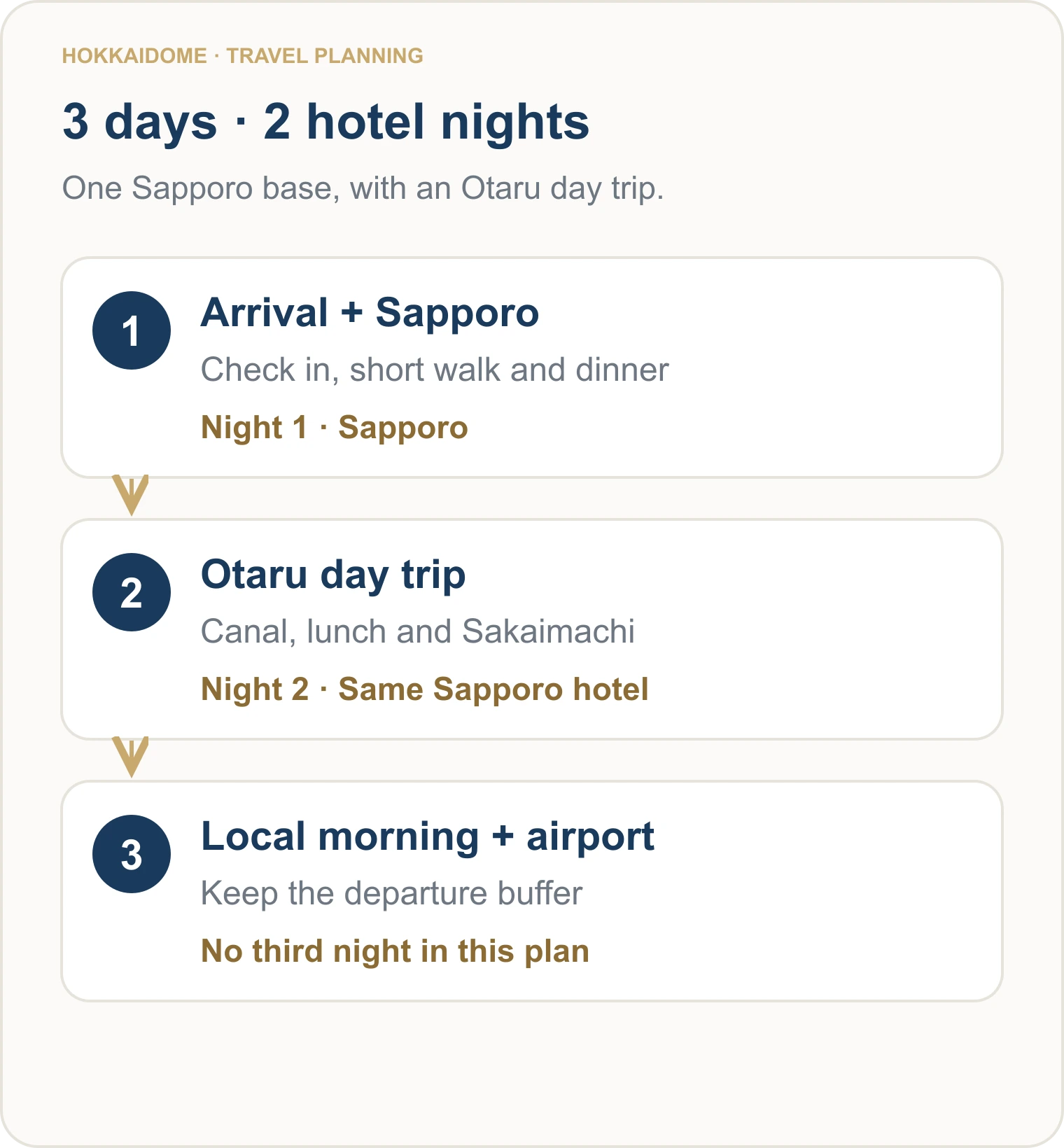
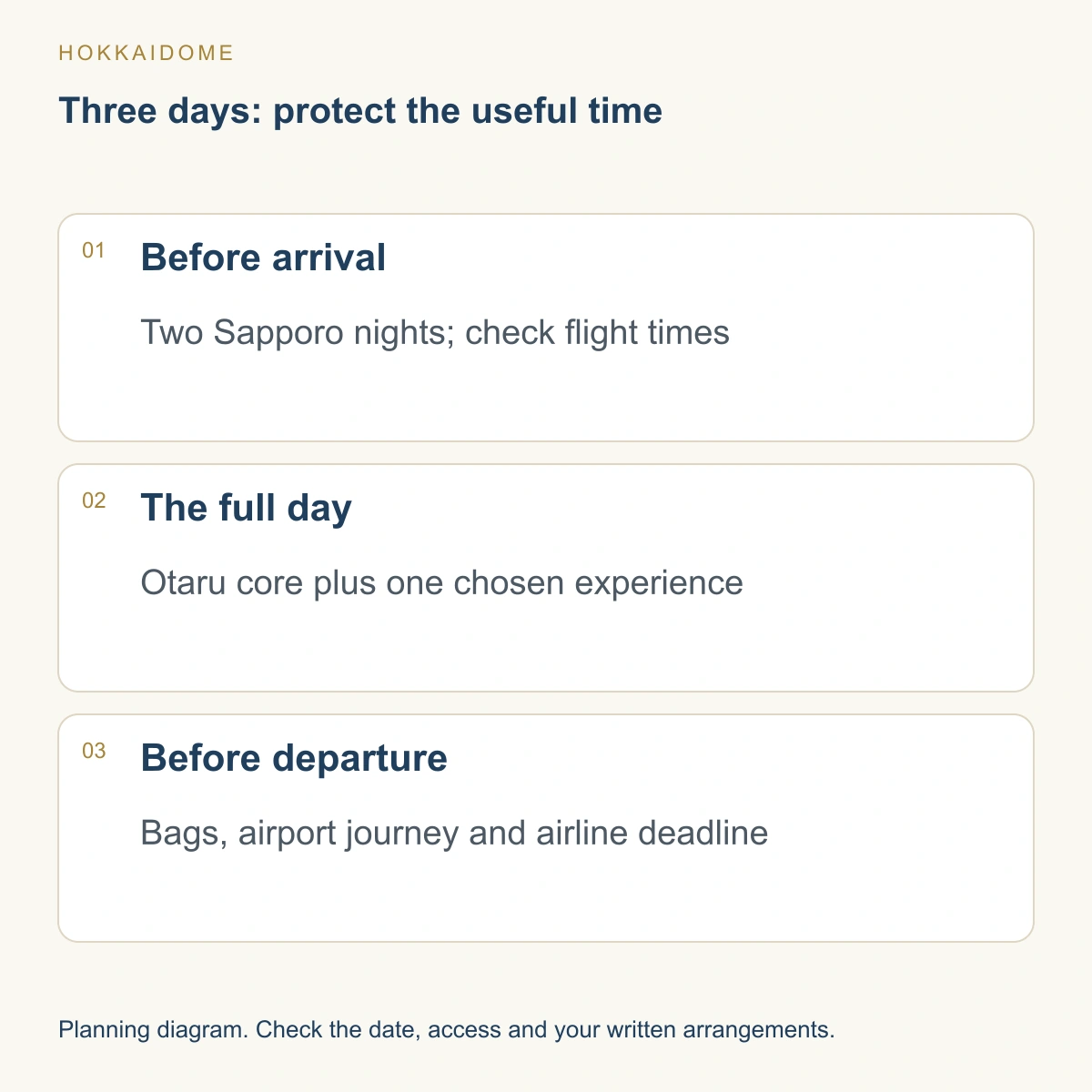
Three calendar days use two hotel nights: arrival and Sapporo, an Otaru day trip, then a local morning and the airport.
Where to stay for a two-night Sapporo base
For this itinerary, a hotel near JR Sapporo Station reduces the station-to-hotel leg on both airport days and the Otaru morning. Odori makes sense if your evening priorities are central walks and shopping; Susukino may suit a food-focused stay, but include the extra local connection when you return with cases. A lower room price can lose its advantage if every journey requires another taxi. Compare the complete two-night cost with the actual walking route and your group’s pace.
Before paying, check the room’s stated occupancy for every child, bed arrangement, breakfast times, baggage-storage policy and the entrance you will use. “Five minutes from a station” can refer to a staircase exit that is inconvenient with a stroller. Ask about a practical lift route rather than assuming a covered connection reaches the lobby. If you prefer an Otaru overnight for the evening canal, replace Sapporo night two: that creates a checkout, baggage and airport-transfer plan to solve, not an extra night inside this two-night route.
Day 1: arrive, settle in and enjoy Sapporo
Airport to your hotel
Begin with the arrival process, not a list of attractions. Leave time to get off the aircraft, collect bags and reach your onward transport. JR’s fastest Special Rapid airport service takes 33 minutes to Sapporo and its fastest Rapid takes 37 minutes; the complete airport-to-hotel journey takes longer.
If you prefer a direct vehicle, compare our New Chitose Airport to Sapporo private transfer. Share the flight, exact hotel and all luggage. A pickup arrangement must be confirmed; the itinerary itself does not reserve a car or establish a meeting point.
Afternoon: one central walking area
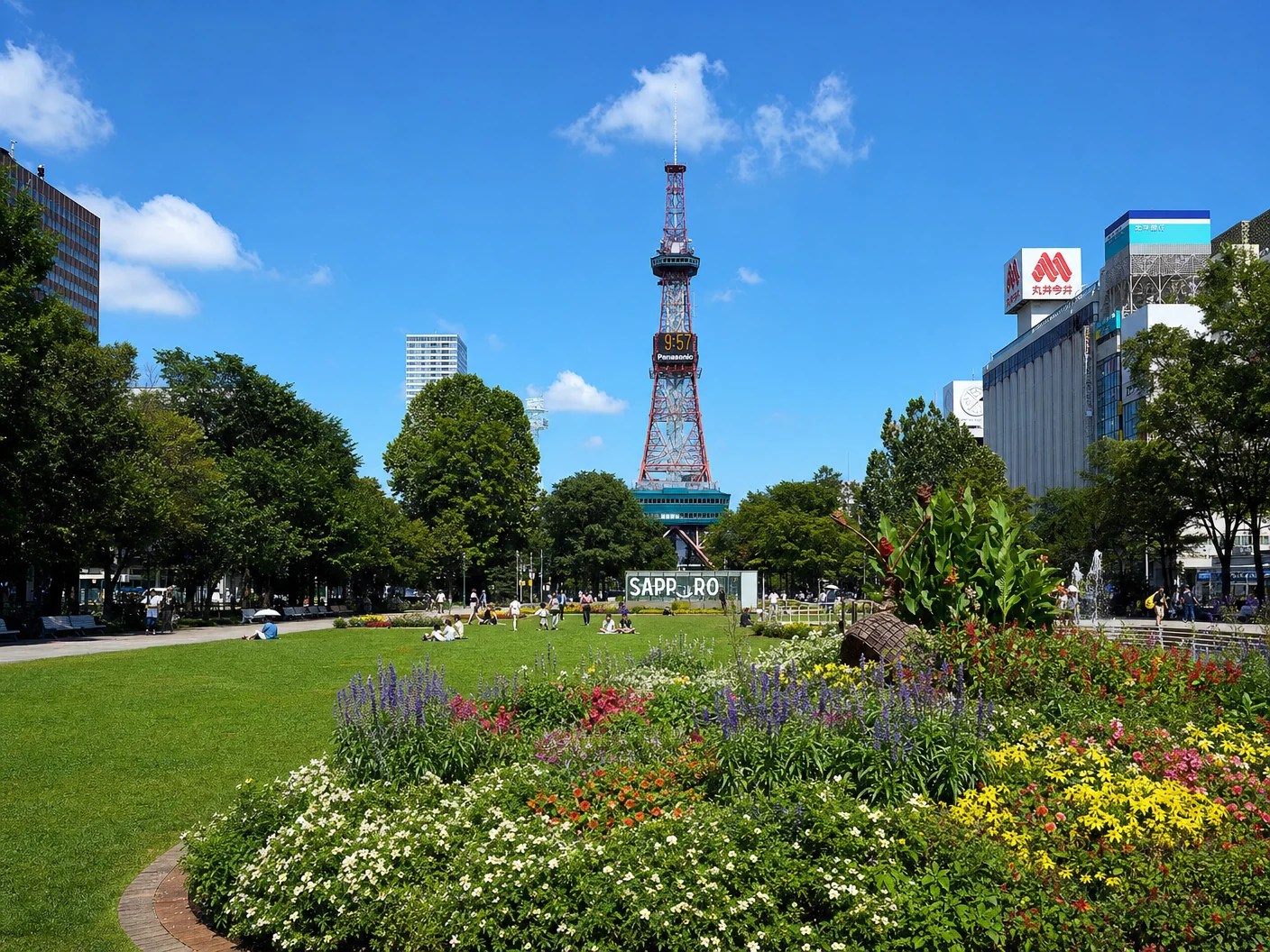
After checking in or arranging luggage storage with the hotel, choose a compact walk around Odori and the central area. Decide whether your priority is a park walk, a historic building or shopping, then give it enough time. Opening arrangements differ by attraction and day, so do not build the first afternoon around several ticketed visits.
If the arrival is delayed, remove sightseeing first. Keep the hotel check-in and a meal. Starting the holiday with a rushed cross-city dash makes little sense when the next morning can begin rested.
Evening: choose dinner before the night view
Sapporo is a good place to try miso ramen, soup curry or a seafood meal. Treat a specific restaurant as a separate choice: check its current opening day, queue or reservation arrangements, and suitability for children or dietary needs. This is a flexible dining evening, not a promise that any named restaurant will have seats.
Add a night viewpoint only if the weather, operating hours and your energy suit it. A city panorama is an optional extra. Families arriving after a long journey may get more from a comfortable dinner and an early night.
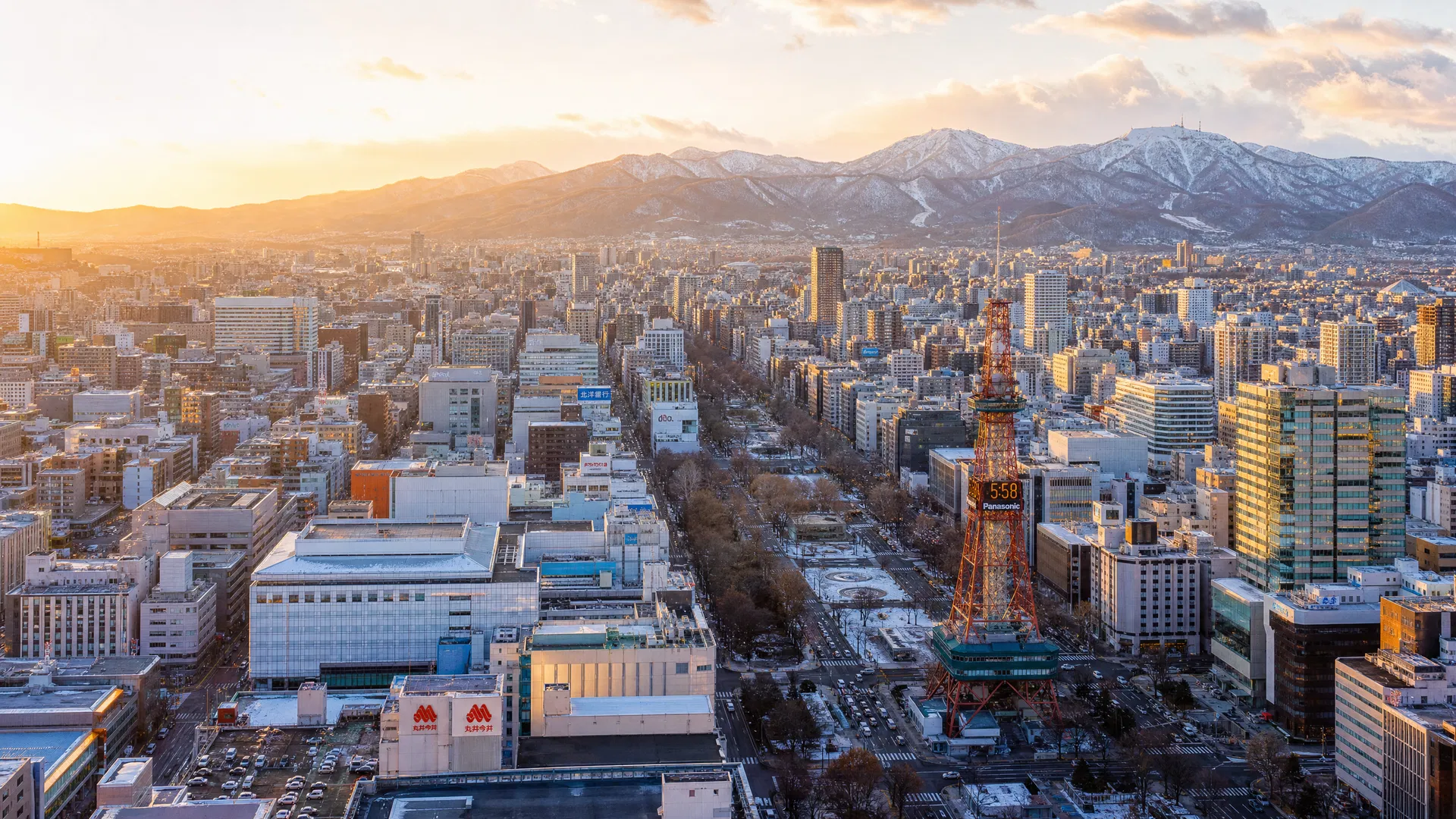
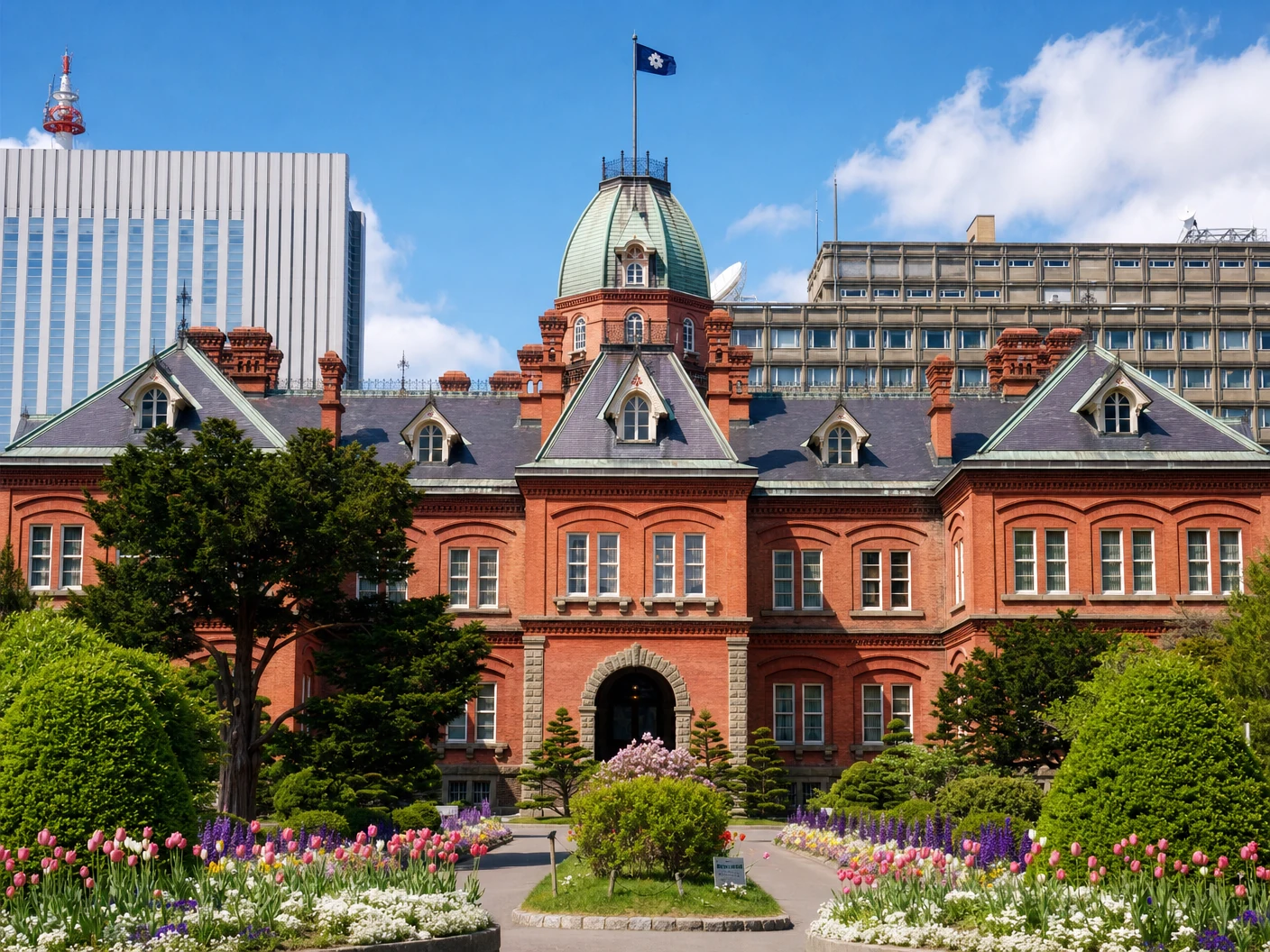
Choose one compact Sapporo area on arrival day. The red-brick government building and its surroundings are one possible city visit; confirm current opening arrangements.
Build one Sapporo walk, with a clear stopping point
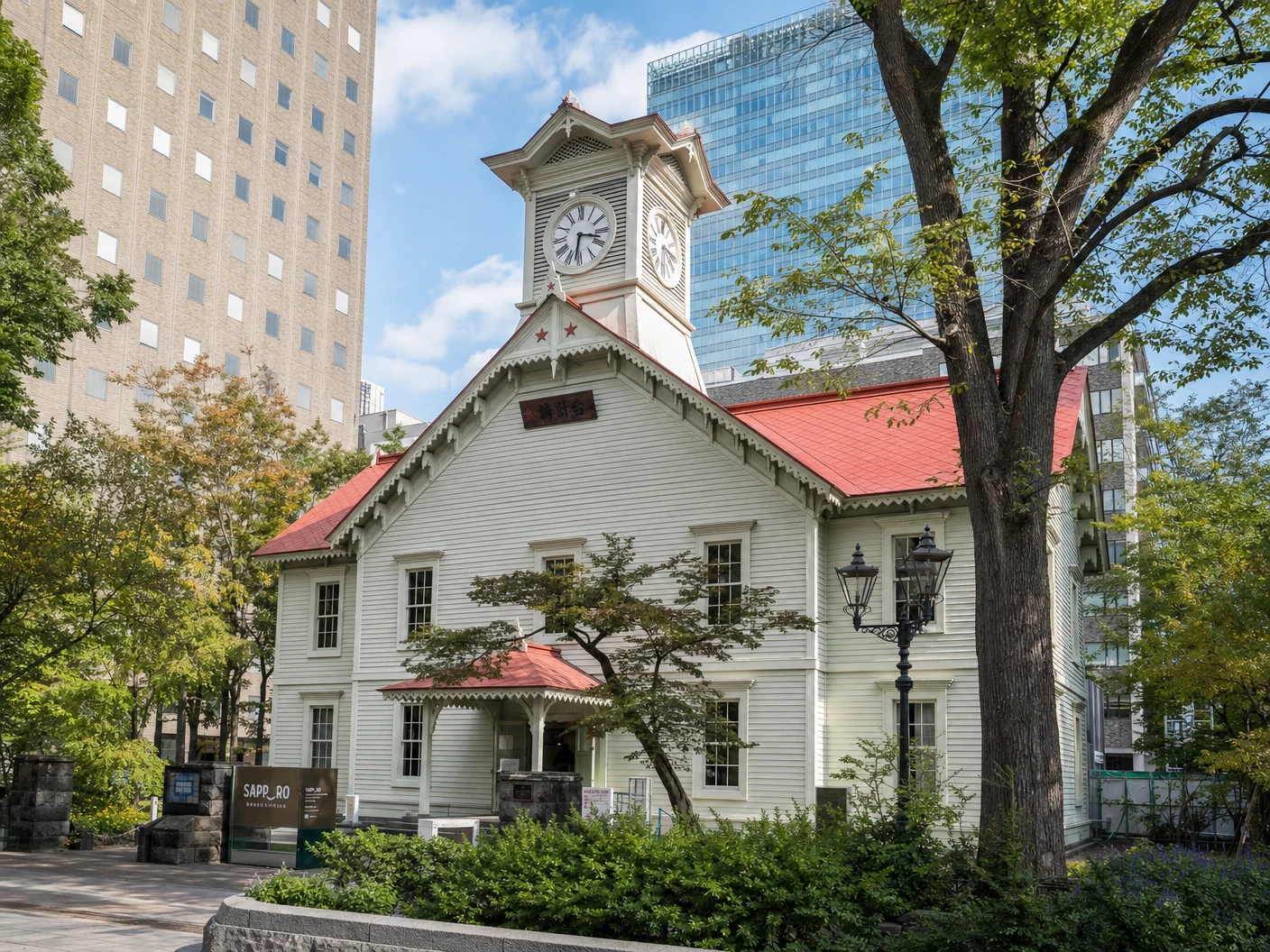
Think of the first afternoon as a connected walk rather than three separate cross-city visits. The station–Red Brick Office–Clock Tower–Odori area offers different stopping points: architecture, a park break or a view from a ticketed attraction. You do not have to enter every building to enjoy the district. Choose one interior visit if its opening hours fit, and leave another for the departure morning only when it is close to your hotel. A market meal, brewery visit and mountain viewpoint each adds another journey.
Put the group’s first proper meal into the plan before adding a timed ticket. Airport formalities, a missed train or a room that is not ready can move the whole afternoon. If you reach the hotel later than expected, use a short local walk and dinner as the complete plan, rather than trying to recover every missed attraction after dark. For a clear evening, choose between a relaxed restaurant booking and a longer viewpoint outing; check the viewpoint’s transport and last entry before committing to both.
Day 2: give Otaru a proper day
Morning: travel light, then walk the canal
Leave large bags at your Sapporo hotel where permitted, and take a small day bag. Check the JR service to Otaru for the date rather than assuming every train has the same journey time or destination. Include the walk to your departure station, waiting time and the walk from Otaru Station in your plan.
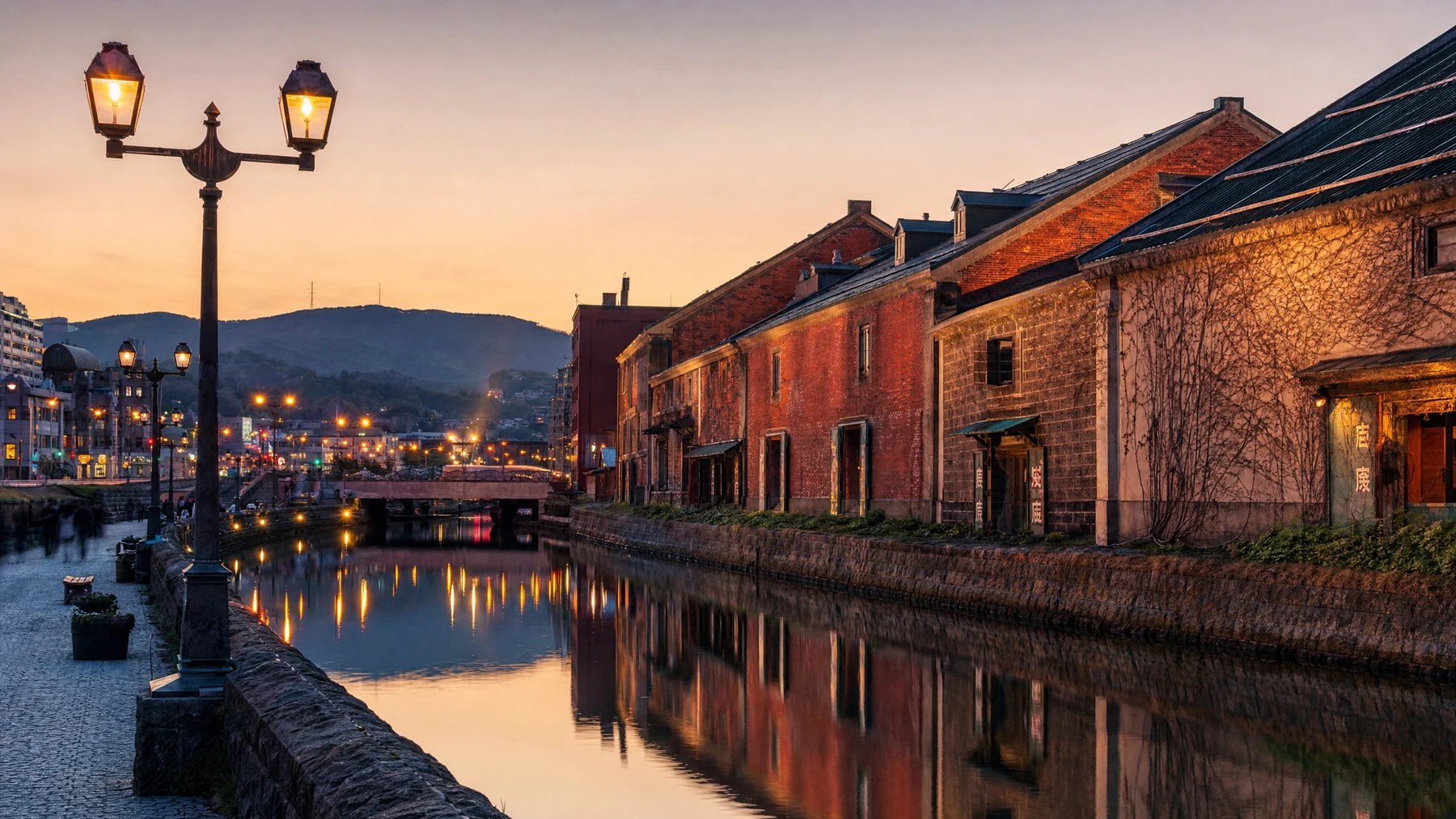
Start with the canal and surrounding warehouse streets. A relaxed first walk helps you decide where to spend the rest of the day. A market breakfast or a museum can be added if it is a real priority; neither needs to become another compulsory stop before the canal.
Lunch and afternoon: Sakaimachi, crafts and a choice
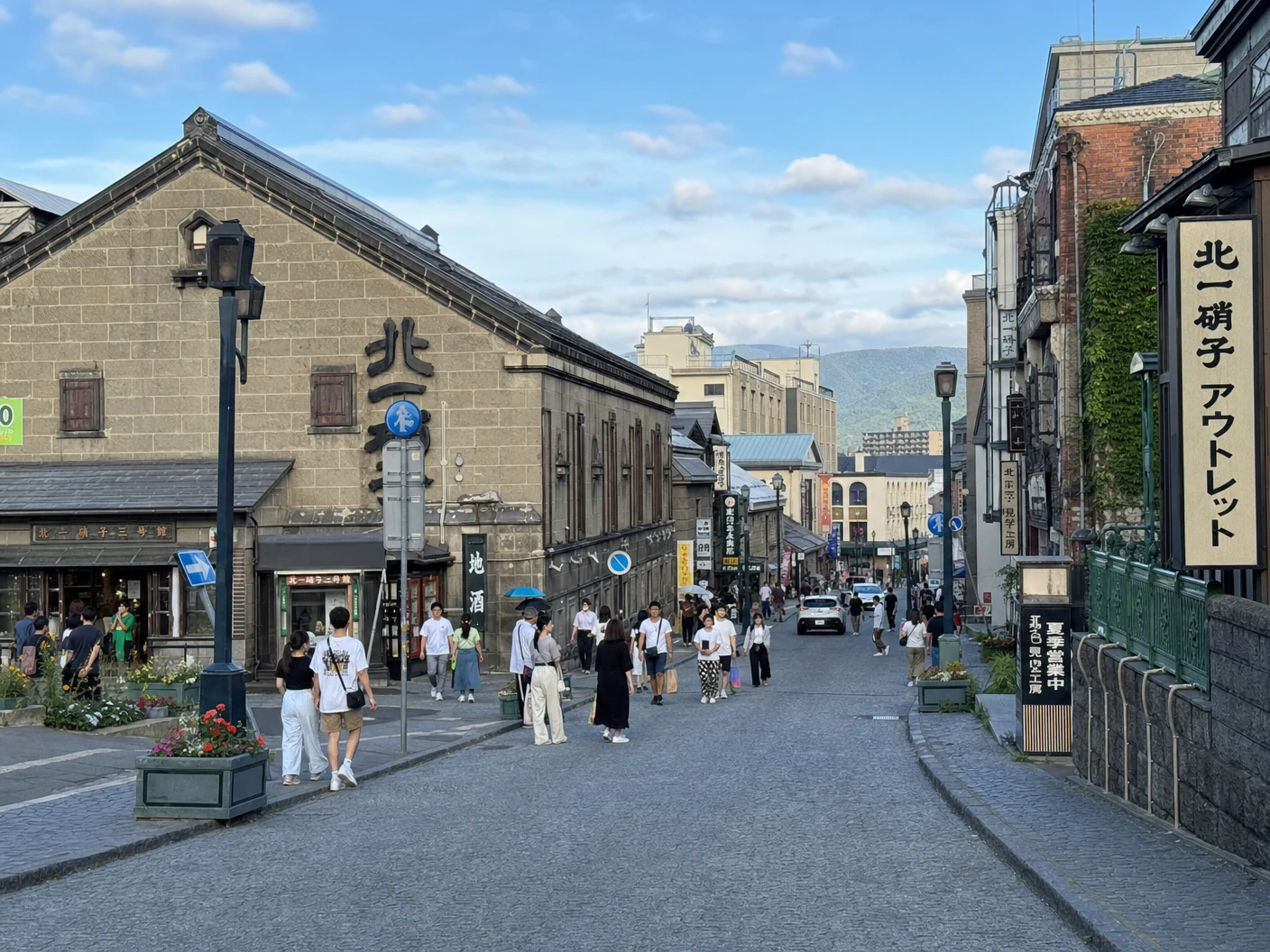
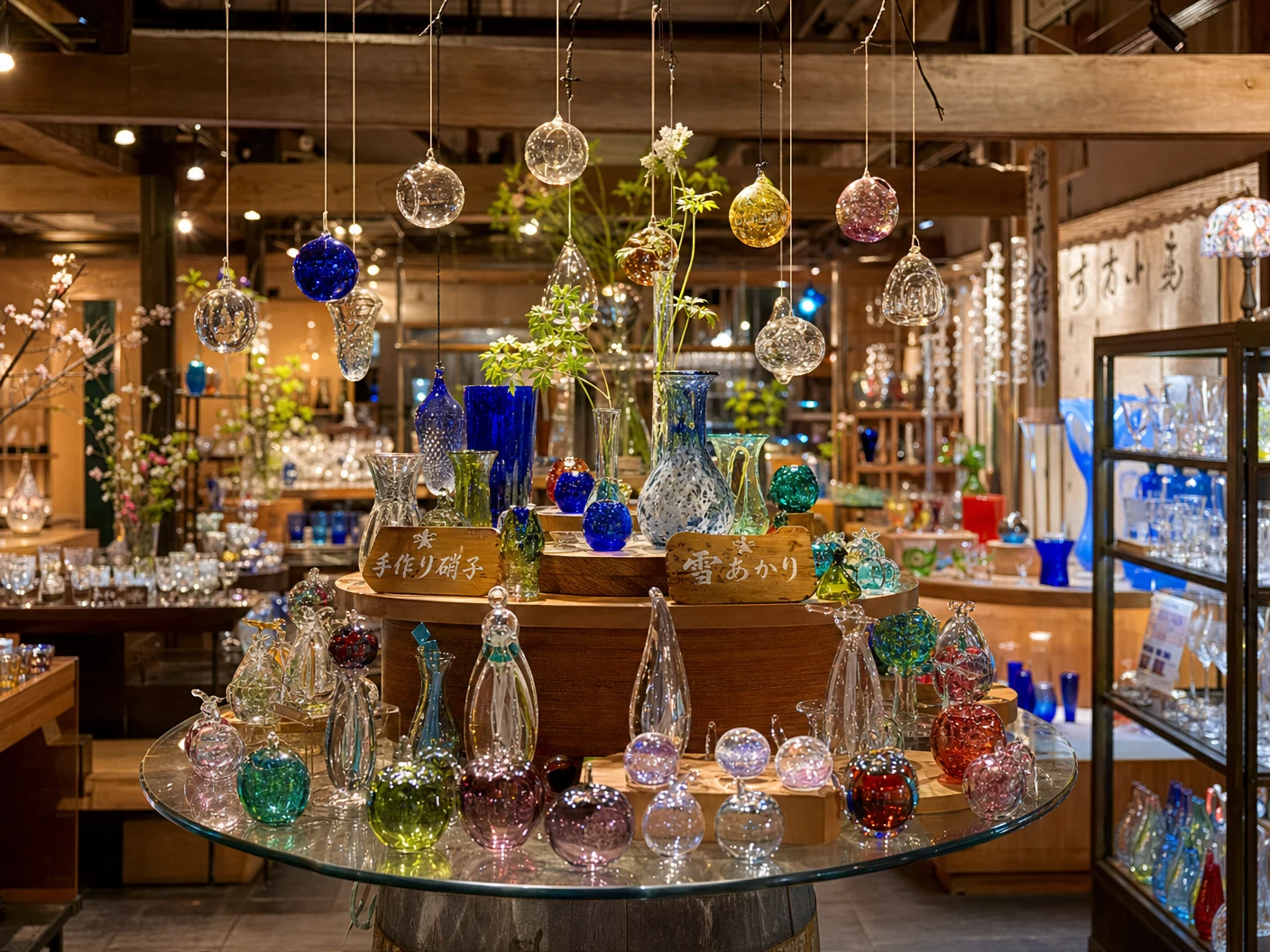
Use the middle of the day for lunch and the Sakaimachi shopping area. Glass shops, music-box browsing and a café break make a coherent afternoon. A hands-on craft activity needs its own booking, duration and collection arrangements, so reserve time for it instead of squeezing it between several attractions.
Choose one optional extension after that: more harbour-town walking, an indoor attraction or a viewpoint in suitable weather. Going onward to Yoichi or a distant coast makes a different excursion. If that is your priority, use our Otaru and Yoichi day-trip guide and adjust the rest of the day.
Evening: return when it suits the group
You can stay for the canal’s later light when conditions and the return transport allow. In winter, balance that choice against the cold and walking pace. Agree the return before starting a long restaurant queue or an extra activity.
Return to the same Sapporo hotel for night two. There is no need to move hotels simply because Otaru appears on the itinerary. A private driver is useful if your group needs a different stop list, less walking or a hotel-to-hotel journey, but the basic canal day can work by public transport.
Give Otaru time for the canal, lunch and Sakaimachi. Stay for later light only when weather, energy and the return transport allow.
Otaru walking plan: canal, Sakaimachi and one booked experience
The canal and Sakaimachi are related parts of a town visit, not a single attraction beside the train platform. Include street crossings, photographs, browsing and a seated lunch in your walking allowance. One useful sequence is station → canal and warehouse streets → lunch → selected Sakaimachi shops → return towards a suitable station. It is a suggested order, not a guided tour. Reverse it if a workshop booking or the weather makes that more practical, and check which station gives the easiest return for your last stop.
Give a glassmaking or other craft booking a real block of time: check the start, activity length, minimum age, language of instruction and whether the finished item is ready that day or needs shipping. A browsing stop at a music-box shop is a different commitment. With young children or anyone who finds icy pavements difficult, shorten the outdoor loop and use a warm café break before continuing. A vehicle can reduce transfers, but it does not remove every entrance walk, slope or pavement; describe those needs when requesting the route.
Day 3: a small Sapporo morning, then your flight
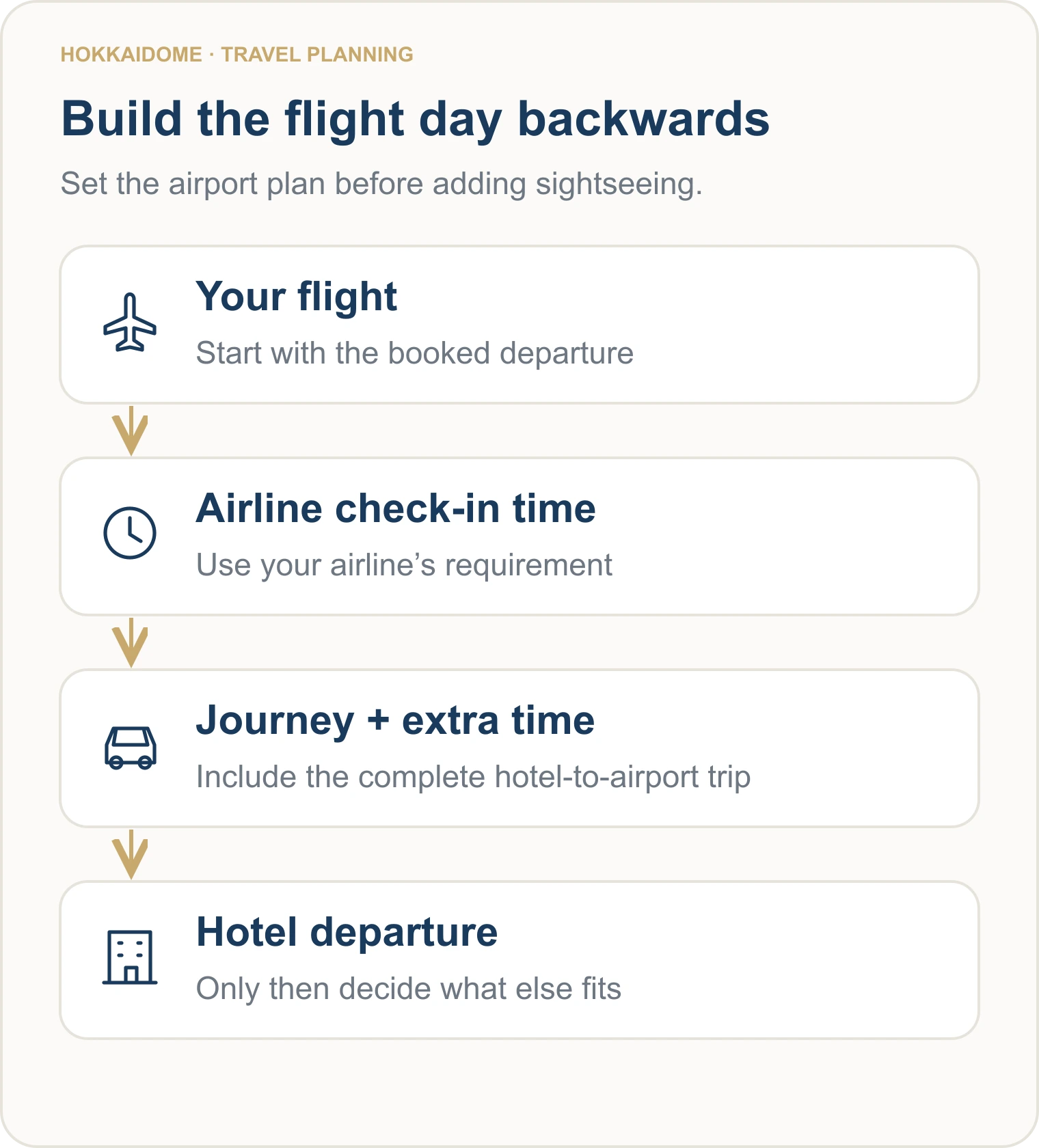
Work backwards from the flight and the airline’s check-in requirements. Add the journey from the hotel, connection or pickup allowance, and extra time appropriate to the season. Only the time left after that belongs to sightseeing. The 33-minute fastest airport train is not a complete flight-day allowance.
For a later departure, choose one nearby activity: breakfast, a short park visit or shopping near your hotel or useful station. Keep your cases accessible and confirm whether the hotel can store them after checkout. Avoid a timed activity on the other side of the city if you would need to rush back for bags.
For an early flight, go directly to the airport. A countryside excursion, skiing session or onsen visit should not be treated as a free extra on every departure morning. If a final private transfer is booked, the confirmation should state the pickup location and time for your actual flight.
Work backwards from the flight and airline check-in requirement, add the complete journey and extra time, then decide whether sightseeing fits.
A departure-day test you can apply to your own flight
Write four separate items beside the flight: the airline’s required airport arrival, the hotel-to-terminal journey, the connection or collection of stored bags, and the seasonal margin. For example, if you choose to reach the terminal at 14:00, do not put a 13:00 activity finish in another neighbourhood merely because a fast train takes under an hour. The activity exit, bags, station walk, waiting and terminal access all occur before check-in. The example is a planning test, not a recommended universal airport arrival time.
Use a stop rule: once the time to collect bags and depart arrives, stop shopping or sightseeing even if the list is unfinished. If the airline changes the flight or the weather affects transport, rebuild the final morning from the new journey, not from the attraction you most want to save. An early flight may justify sleeping near the airport on the second night, but that changes the simple two-night Sapporo base and should be arranged before you book the rooms.
How to adapt the short route by season
Winter
Shorten outdoor walking, schedule warm breaks and keep an indoor alternative. Check event dates separately. A service disruption can mean spending day two in Sapporo instead of chasing the original stop list.
Green season
Keep the Otaru day relaxed and use suitable weather for a local park or viewpoint. Lavender country needs a dedicated route; flower-field photographs are not a reason to add a distant stop to every short city stay.
Spring and autumn
Choose walks for actual conditions rather than a fixed blossom or foliage promise. Keep rainwear and a warm layer accessible, and verify whether your chosen seasonal activity is operating.
For a longer countryside visit, compare the five-day Hokkaido itinerary. If skiing is the purpose, build the holiday around the resort and use a confirmed airport-to-Niseko transfer instead of adding a rushed overnight to this plan.
Rain, snow or a delayed arrival: change one decision at a time
Before travel, agree the part everyone most wants: the canal walk, a craft booking or a Sapporo food day. If day two is wet but transport is normal, shorten the canal section and keep a chosen indoor visit, lunch and warm breaks. If walking conditions are poor or services are disrupted, a Sapporo day may be more sensible. A flexible plan is not permission to assume a particular shop, museum or booked vehicle is available; reconfirm openings and changes with the relevant provider.
Keep medicines, a warm layer, charging power and your return details in the day bag rather than the suitcase at the hotel. For children, plan a seated meal and toilet stop before a long walk, and give the slowest walker a realistic return time. Save the hotel address and the day’s bookings offline. These small arrangements protect the only full day more effectively than adding another distant destination. If the group’s central goal is rural scenery or skiing, use the alternative routes below and rebuild the short break around that goal.
Choose transport for the day you actually need
The core plan can be followed without self-driving. Rail handles the airport and Otaru journeys, with city transport and walking in Sapporo. Compare your exact tickets and local connections before buying a pass. A short stay does not automatically justify an island-wide rail product.
A private car can help with several children, large suitcases, limited walking or an agreed off-station route. Ask whether you need only the airport legs, one sightseeing day or a longer arrangement. Check the full price and inclusions rather than comparing a per-person rail ticket with an incomplete vehicle headline.
HokkaidoMe’s published yen guide explains charter starting rates and conditions. Your own hotels, meals and attraction admissions are separate from a car-and-driver quote unless specifically stated. A specialist guide is a separate request; our planning team uses English, while drivers assist with conversational English and translation apps.
Three-day rail budget: compare the tickets you will actually use
A useful starting calculation is the airport–Sapporo return plus a Sapporo–Otaru return. JR Hokkaido’s regular-fare page checked on 7 November 2026 lists ¥1,230 each way for the non-reserved airport journey and ¥800 each way between Sapporo and Otaru: 2 × ¥1,230 + 2 × ¥800 = ¥4,060 per adult. This is a basic rail example for those four rides, not the total holiday cost. Local subway or bus journeys, seat upgrades, admissions, food and accommodation are outside it. Recheck fares before purchase.
Compare a pass against this route rather than the number of calendar days in its name. Check eligibility, covered lines, local buses and any reservation requirements separately; a pass cannot turn infrequent transport into a frequent service. Likewise, a private-vehicle quote is normally a group transport amount with its own scope, whereas a rail fare is per passenger. Put them on the same basis: every person, cases, local connections, the agreed hours and the complete JPY total. Ask for a direct transfer and a sightseeing day as separate options if that is what you need.
When to choose another three-day route
If Furano’s flower fields are the reason for the trip, make central Hokkaido the focus and check your airport and hotel combination. If Niseko skiing is the priority, stay where you can use the mountain rather than making it a sightseeing stop between city visits. Either choice can be worthwhile, but it replaces this route.
Changing a two-night trip: decide what to give up first
There is only one full sightseeing day between arrival and departure. Before paying for an extra experience, write down the part of this plan that it replaces. A different hotel can be a worthwhile choice, but moving bags and meeting a dinner or check-in deadline uses part of the same day.
Your priority
Change to this plan
Resolve before booking
An evening in Otaru
Replace the second Sapporo night with Otaru; do not retain both hotel bookings.
Where the bags will go, the next morning’s airport journey and whether the return flight still leaves enough time.
An onsen stay
Exchange the Otaru day or another substantial part of the trip for the chosen onsen area.
The hotel’s arrival and meal deadlines, transport and the actual time available for the bath; do not assume every room plan includes dinner.
A timed experience in Yoichi or elsewhere
Remove a substantial block of the Otaru walk rather than adding it after every canal and shopping stop.
The experience time, available language, outward and return services, and the remaining time for Otaru.
Keep the original Sapporo base if the change needs rushed luggage collection or an uncertain connection. If flower fields, skiing or another distant destination are the main purpose, choose that route before the flights and rooms, rather than treating it as an extra stop on this short city break.
Three-day Hokkaido itinerary questions
Is three days enough for Hokkaido?
Three calendar days can make a rewarding short break around Sapporo and Otaru. With arrival and departure included, it is not three full sightseeing days. Choose one main day trip and leave time for the airport instead of trying to cover the whole island.
How many hotel nights does this itinerary use?
Two nights, both in Sapporo. Day one is arrival, day two is the Otaru day trip, and day three is a short Sapporo visit plus departure. If your flights arrive late or leave early, reduce the sightseeing rather than adding another night silently.
Can I follow the three-day itinerary without a car?
Yes. The core route uses the airport railway, Sapporo city transport and the JR connection to Otaru. Check your hotel’s station access and chosen train. A private transfer or driver is an optional way to handle luggage, walking limits or additional off-station stops.
Should I add Niseko or Furano to a three-day first visit?
Make either one the focus of a different route rather than adding it to this city-and-Otaru plan. A ski stay needs useful resort time, while a Furano and Biei day needs substantial travel. Our separate model-itinerary page compares other three-day private-car routes.
Can we go to Jozankei on the departure day?
Only if the flights and confirmed transport leave a sensible buffer. For most short departures, a local Sapporo morning is easier. If an onsen visit matters most, replace part of the plan or add a night rather than hoping a distant bath fits before an early flight.
Does the itinerary work in winter?
The city-and-Otaru structure remains useful, but allow more walking time, plan warm breaks and check service conditions. Seasonal events need their own dates and hotel planning. A snowstorm or transport disruption can mean replacing the day trip with a city day.
Is the airport transfer included in a sightseeing quote?
Only when the written quotation includes it. Give your flight, hotel, route and luggage details. A standalone airport transfer, a full sightseeing day and a multi-day arrangement are different bookings; confirm the inclusions and total before reserving.
Useful official planning links
Reviewed 7 November 2026 by the HokkaidoMe planning team. The day-by-day plan is our suggested pacing, not an operator timetable or a fixed package. Confirm current transport, opening days and event dates before booking.
Share your flights, two-night hotel plan, party size, luggage and the stops that matter most. Tell us whether you need airport transfers, an Otaru day or another specific private-car arrangement.
We reply in English with availability and a personalised quote. A form enquiry does not create a confirmed reservation.
Fields marked * are required. Please use your local travel dates in Japan.