Japan connectivity · practical Hokkaido planning
eSIM vs Pocket WiFi in Japan: Choose Your Connection
Choose a connection for the way your group travels. Compare compatible phones, shared devices, real trip totals and what to arrange before leaving the airport.
eSIM vs pocket WiFi in Japan: start with your travel day
Choosing between an eSIM and pocket Wi-Fi for Japan is easier when you picture an ordinary day of your trip. Will everyone stay together, or will one person ski while another shops? Do you need only phones, or a laptop as well? Can your exact phone use the product you are about to buy?
For Hokkaido, the decision also includes long journeys between towns, a clear airport meeting point and rural stops where any network may have gaps. This guide compares the formats and the questions that affect the total cost. Prices and conditions should be compared for the exact product and travel dates.
| Option | What it does | A useful fit | Main checks |
|---|---|---|---|
| Travel eSIM | Adds a supported mobile plan digitally to a compatible phone. | People wanting an individual data connection. | Exact device, carrier lock, validity start, network and hotspot rules. |
| Physical travel SIM | Uses the phone’s compatible SIM slot. | A suitable unlocked phone where eSIM is unavailable or inconvenient. | SIM slot, supported networks, setup and keeping the home SIM safe. |
| Pocket Wi-Fi router | Shares a mobile connection with nearby Wi-Fi devices. | A group staying together, tablets or laptops. | Total rental days, battery, shared allowance, collection and return. |
| Home-carrier roaming | Uses your existing carrier’s Japan roaming arrangement. | A traveller whose current plan has suitable included data or a pass. | Japan inclusion, daily trigger, data limits, voice and SMS charges. |
Before buying an eSIM, check the exact phone
Check the manufacturer’s model and regional version, then the provider’s compatibility information. A phone family name alone is not sufficient. A carrier lock can also prevent using a different provider even when the hardware supports eSIM.
Apple’s international eSIM guidance explains carrier-lock checks and notes regional differences, including certain Hong Kong and Macao models that use two physical nano-SIM cards. For Android, use the manufacturer’s support information for the particular model and the travel provider’s own supported-device list. Do not rely on a blanket statement such as “all recent phones work”.
If your device needs a physical SIM, confirm that it has the required tray and is compatible with the product. If it cannot use a local SIM or eSIM, a Wi-Fi router or a suitable home-carrier roaming plan can still provide a connection. Make that decision before committing to a non-refundable product.
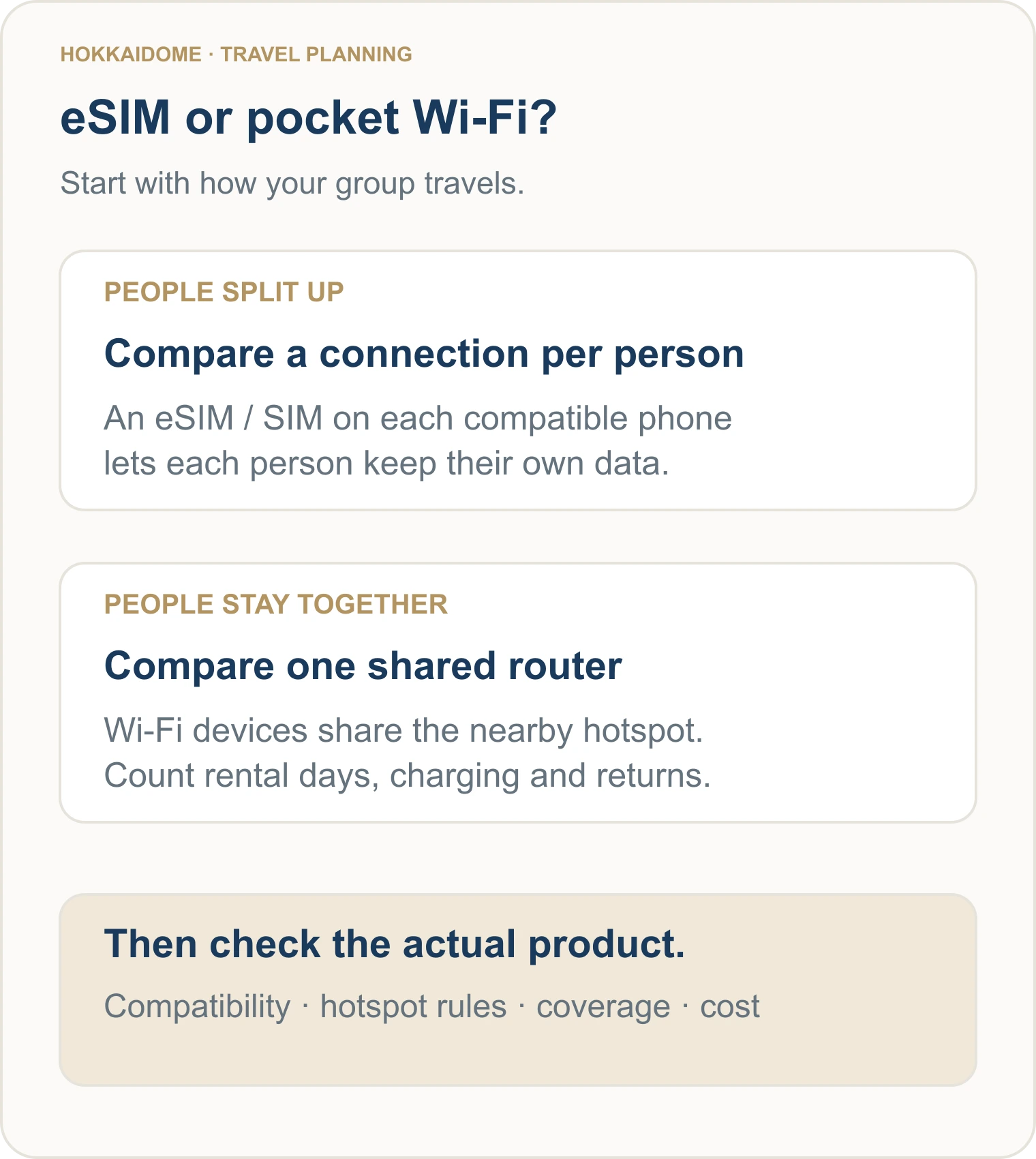
What happens when the group splits up?
A router shares a connection with devices close enough to use its Wi-Fi network. If it stays in one person’s bag, someone who walks away needs their own connection or must wait until they are together again. The same practical issue applies when one phone supplies a personal hotspot.
For a family that travels together, one router can be convenient: phones and a tablet can connect to the same device, and the setup may be familiar. Decide who carries it, who charges it and how everyone reconnects after a break. Check the actual product’s device limit and data allowance rather than assuming every router supports an unlimited number of users.
For independent adults, separate mobile connections can be simpler. Each person can check their own route and contact the hotel or group without staying near the hotspot. That may matter more than a small price difference. A mixed arrangement can also work: individual phone data for the adults and hotel Wi-Fi for larger downloads.
For remote work, check tethering, expected data needs and the accommodation’s internet arrangements separately. A consumer travel-data product should not be assumed to guarantee a constant video-call speed. If work depends on a connection, discuss the actual requirement with the provider and plan an alternative.
Compare the allowance, not just the word unlimited
Read the product-level description for total data, daily high-speed limits, reduced-speed behaviour, top-ups and hotspot sharing. These are different questions. A plan may allow extensive on-phone use while limiting data shared with a laptop or another phone.
As a concrete example of that distinction, Sakura Mobile’s own product guidance describes an unlimited on-device SIM/eSIM product with a separate hotspot fair-use restriction. This is an illustration of why the exact conditions matter, not a recommendation to buy that product. Other products, including those from the same seller, can have different rules.
Estimate your needs from the trip you will actually take. Messaging and occasional searches are different from daily video uploads, long calls or sharing a connection with several laptops. Download large non-essential files over suitable Wi-Fi when convenient and keep the provider’s data-usage screen easy to find.
| Question | What to compare |
|---|---|
| How long is the trip? | Count the covered days, arrival date, departure date and the validity time zone. |
| What happens after the allowance? | Reduced speed, stopped data, automatic charges or a manual top-up. |
| Can I share it? | Whether hotspot use is allowed, its separate allowance and the device limit. |
| What support is available? | Contact method, operating hours and how to reach support without that data connection. |
| Do I need ordinary calls? | Whether the plan includes a number, voice and SMS, or is data-only. |
A simple cost comparison for four travellers
Use the complete trip total in one currency. Multiply a per-phone product by the number of people buying it. Multiply a daily router rental by all chargeable days, then add delivery, return, insurance or other chosen extras. Check whether tax is included. A headline daily figure is not the final group cost.
The numbers below are an illustrative calculation only, not current provider prices or a HokkaidoMe offer. Replace them with the actual quotes you are comparing.
| Illustrative choice | Calculation | Example total |
|---|---|---|
| Four separate data products | JPY 2,000 × 4 people | JPY 8,000 for the group |
| One seven-day router rental | JPY 700 × 7 chargeable days | JPY 4,900, before any extras |
| The decision after price | Who needs a connection when the group separates? | Value depends on the travel pattern, not the lower total alone. |
For home-carrier roaming, inspect your own plan before assuming it is expensive or free. Your plan may include Japan data, offer a pass, or charge when a particular event triggers a daily fee. Ordinary calls and SMS can have separate rules. A travel eSIM does not automatically stop charges on an enabled home line.
New Chitose Airport: get connected before moving on
The airport’s official service directory lists Wi-Fi, mobile Wi-Fi rental and prepaid SIM vending services. Use the provider’s current terminal location and collection hours for your booking. Do not assume a domestic-terminal counter is beside your international arrival gate or remains open for a delayed flight.
If collecting a router, confirm the pickup name, required documents, included accessories and return method. If arranging hotel delivery, confirm that the property can receive it and that the package will be there when you arrive. Keep the return deadline and packing instructions with the device rather than remembering them on the flight day.
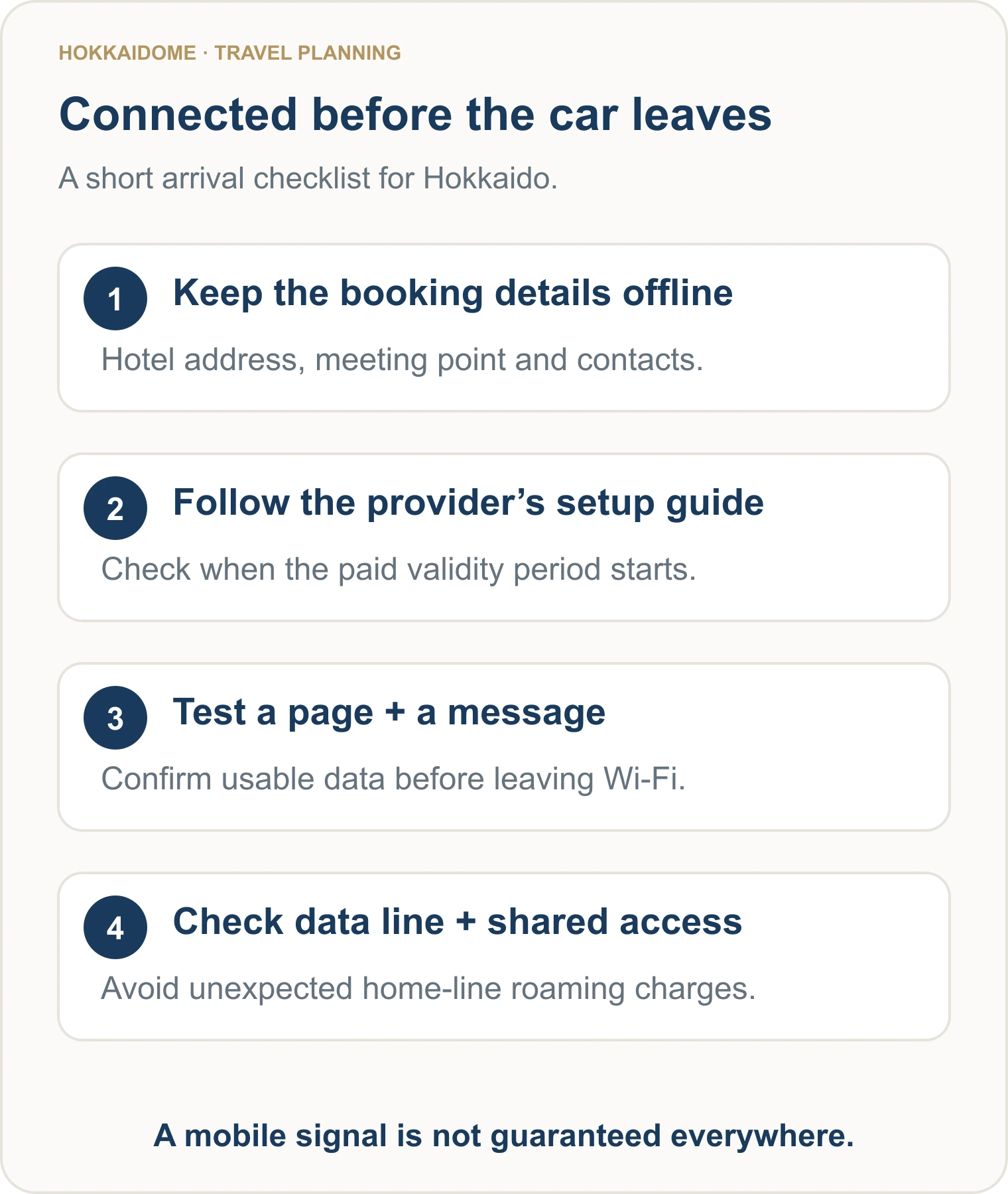

For a private pickup, save the meeting point and contact instructions before flying. A screenshot of the hotel’s full name and address remains useful if mobile data fails during arrival. Test a simple page and message after setup, then use the provider’s troubleshooting guide if necessary. Do not leave the airport relying only on an icon that appears to show a signal.
Rural Hokkaido and useful offline preparation
Ask which Japanese network the actual product uses and inspect the operator’s current coverage information for the places you will visit. The NTT DOCOMO service-area page is one example when your product uses that network. A network name alone cannot guarantee reception in a particular building, valley or moving vehicle.
Keep accommodation addresses, reservations, meeting details and essential contacts available offline. Use an offline map where the app supports the area, and test the saved material before depending on it. Google’s own offline-map guide notes that offline transit and walking directions are unavailable, and offline driving lacks live traffic and alternative routes. A downloaded map is therefore only part of a travel plan.

For a sightseeing day, agree the meeting point and pickup time with the driver even when everyone has data. Connectivity helps coordination; it does not replace a clear itinerary. The Hokkaido transport guide and Sapporo private-driver page explain options for the journey itself.
HokkaidoMe arranges private transport, not mobile service or activation support. Buy connectivity from the provider whose terms and device requirements fit your needs. Use the enquiry form below for the car journey, sharing dates, hotels, people and luggage rather than SIM activation codes.
Japan eSIM and pocket Wi-Fi questions
Is eSIM or pocket WiFi better for Japan?
Choose according to compatible devices and how your group moves. Separate eSIMs or SIMs can suit people who split up; one router can suit a group that stays together and shares several Wi-Fi devices. Compare the actual total, data allowance, hotspot rules and pickup or return arrangements rather than assuming one format is always cheaper.
Will an eSIM work on my phone?
Check the exact model, regional version, carrier-lock status and provider compatibility list before purchase. A familiar model name or a recent purchase date is not enough. Apple notes that regional variants can differ, including certain Hong Kong and Macao models. Android users should check the manufacturer and provider for their exact device.
Does unlimited data include unlimited hotspot sharing?
Not necessarily. A plan’s on-device allowance, tethering allowance and fair-use rules can differ. Read the exact product conditions, including reduced speeds and top-up options. One provider can sell several products with different networks and rules under a similar unlimited label.
Can I buy a SIM or collect pocket WiFi at New Chitose Airport?
The airport lists prepaid SIM vending and mobile Wi-Fi rental services. Check the current terminal, operating hours, reservation conditions and collection deadline for the actual provider. A late arrival may need a different arrangement, and a vending machine does not guarantee a suitable product is in stock.
Will I have signal everywhere in Hokkaido?
No mobile product can promise service at every rural stop, inside every building or along every mountain road. Check the product’s underlying network and the operator’s area map for the specific places you will visit. Keep essential addresses and meeting details available offline.
Does a data-only eSIM give me a Japanese phone number?
Do not assume so. A data-only product provides internet access, while ordinary voice calls and SMS require the appropriate service. Check the product description if you need a local number. Keeping your home line enabled can have separate roaming charges under your home plan.
Can one person share an eSIM with the whole family?
A phone hotspot may work if the plan and device allow it, but other people need to stay within its range and the host phone needs enough battery. Check hotspot limits and what happens when the group splits up. Compare that with separate connections or a dedicated router.
Should I activate an eSIM before leaving home?
Follow the actual provider’s instructions. Installation, activation and the start of paid validity are not always the same event. Confirm when the allowance begins, how to set the travel data line and whether that product needs data roaming enabled. Test the connection on arrival before leaving available Wi-Fi.
Check the product and the device at the source
Reviewed 18 October 2026. Product conditions change. This is a format comparison with a clearly labelled arithmetic example, rather than a live provider-price ranking. Use the actual product and manufacturer instructions before purchase.
Plan it with HokkaidoMe
Plan the Hokkaido journey itself
For a private car enquiry, share your dates, hotels, passengers, luggage and main interests. For a SIM, eSIM or router setup question, contact the mobile provider directly.
We reply in English with availability and a personalised quote. A form enquiry does not create a confirmed reservation.